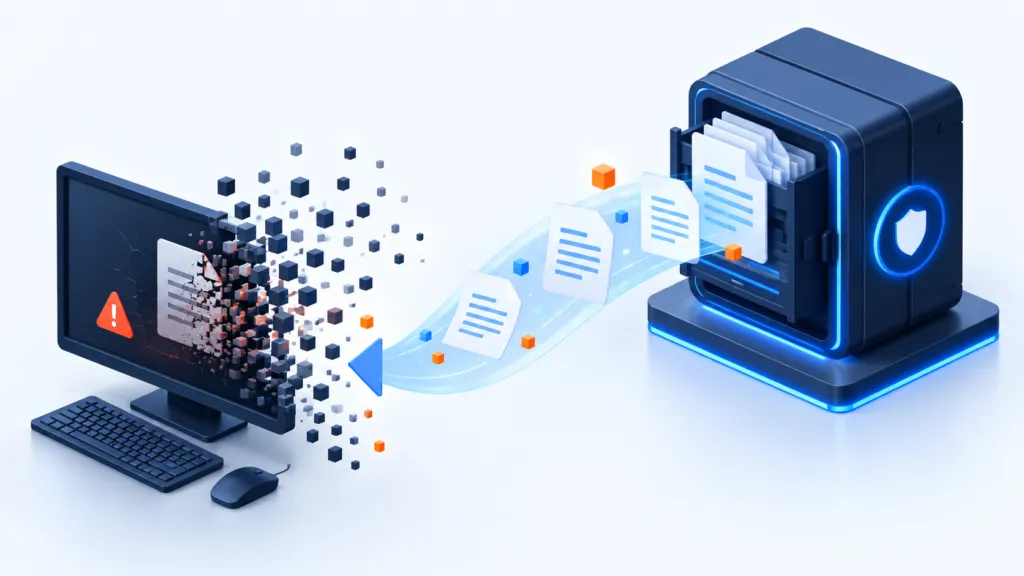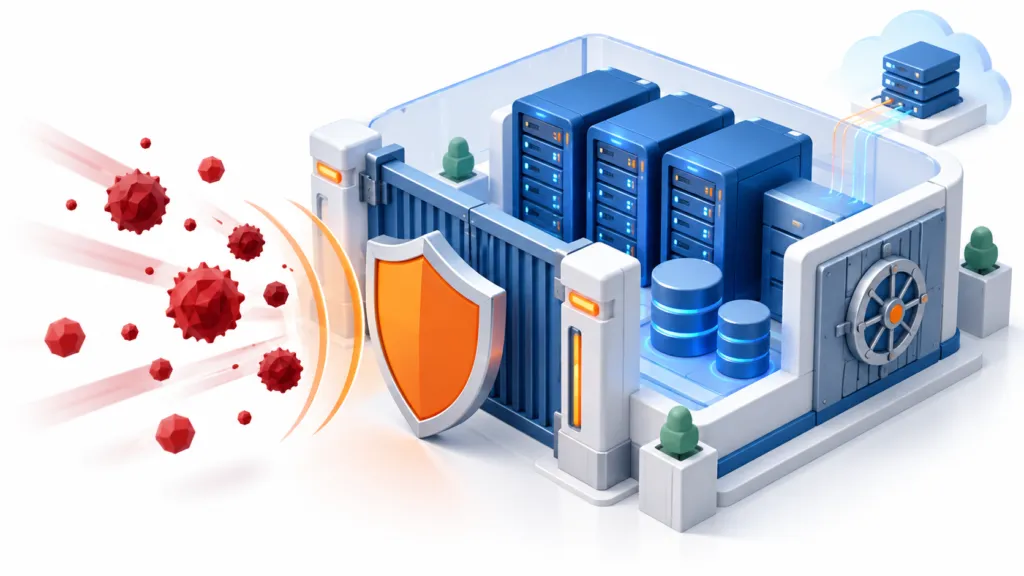
Another term in English has entered the conversation: Cyberstorage. Before adding it to the list of things to buy, let's understand what it is trying to solve. Like Zero Trust, virtualization, and disaster recovery, the idea here also begins with a practical need: to protect business operations and information when attackers target the storage itself.
The key principles
- Protect the storage
- Separate permissions
- Check resilience and recovery
Organizations want to make it difficult for attackers to alter operational data and destroy backups. Cyberstorage describes capabilities for protecting information in storage against cyberattacks. The three questions worth asking are what the term means, what value it provides, and what can be implemented right now.
When the attacker reaches both data and backups
Here, the storage itself is in the spotlight: short- and long-term repositories with sensitive or critical information, as well as local and cloud backup destinations. In other words, it’s not only the work system that needs protection — also the place from which you planned to restore it.
The source focuses on two patterns: ransomware, which includes theft and encryption of information, and espionage or sabotage, which involves deletion and alteration of data. It distinguishes these from the deletion of local logs intended to conceal the attacker's actions.
The document cites that in 86% of the attacks examined, information was stolen, including large volumes, and that in 95% there was an attempt to access storage to harm backups. It notes damage to some backup repositories in 38% of cases and to all repositories in 30%. The cited sources are the Coveware report for Q2 2022 and Veeam's 2022 ransomware trends report.
The source raises the possibility that attackers may shift their focus from encryption, which creates noticeable downtime and draws authorities' attention, to stealing information and threatening to publish it on the dark web. Encryption is a means to pressure the victim, not the economic goal itself.
Whether encryption is used or not, damage to systems, exploitation of permissions, harm to Active Directory, and lateral movement across the network may necessitate restoring the environment to a trustworthy state before the attack.
A useful idea or just another word for a presentation?
Does Cyberstorage help deal with attacks on storage, or mainly add a term to the conversation? To answer, the author breaks down the definition into principles and examines how to apply them. This is a good way to understand technology: start with what it does, not how impressive the name sounds.
The author thinks it is worthwhile to know the concept because it helps focus the conversation on what needs to be protected and how. At the time of writing the document, he described it mainly as a concept and a basis for discussion, not as a well-defined product that must be purchased.
The source refers to the Gartner Hype Cycle for storage and information protection technologies. In the cited graph, Cyberstorage is at the Innovation Trigger stage, the beginning of interest in innovation. The marking of 5–10 years describes Gartner's forecast for the time until maturity, when solutions provide value in a consistent way.
The author emphasizes that forecasts are not always accurate, and the existence of vendors offering products in the field does not contradict the fact that the field is still developing. The message is to examine the intent of protection and see how those goals can be advanced using existing strategies.
What did Gartner mean when it said Cyberstorage?
The term gained prominence in the Gartner report from July 2022. According to the definition provided in the document, Cyberstorage protects storage system data from ransomware by early detection and blocking of attacks, and helps with recovery through analysis that identifies when the attack began. The solution can be software, a dedicated device, or integrated as part of the storage solution.
The author derives two main courses of action from the definition:
- Stop attacks at an early stage: If access can be prevented before operational data or backup data is affected, the organization's situation is better.
- Understand when the attack began: If it wasn't stopped, it is necessary to know when stations were affected, when library services were exploited, and when data was accessed or altered. This way, it is possible to avoid restoring a system that was already compromised during the period when the attacker was operating undetected, and to select a point that has been verified both in terms of trust and safety.
The definition does not require a single hardware technology. It describes the protection objectives and the relationship between detection, blocking, and recovery.
Three additional goals
The document cites three objectives from the report:
- To prioritize active protection of unstructured information storage, since limiting or blocking an attack is preferable to recovering from it.
- To harden the existing storage solution through vulnerability management and vendor recommendations.
- Not to consider Cyberstorage products as a substitute for backup, immutable backup vaults, network monitoring, or disaster recovery.
The author simplifies this into three principles:
- Attack prevention: To limit or block it before recovery is required.
- Information protection: To prevent unauthorized access to storage even if the prevention layer did not stop the attacker.
- Multi-layered strategy: To combine backup, protected repository, recovery plans, and monitoring, with additional capabilities for prevention, detection, and response.
What can be done with the tools that already exist?
It is not necessary to start with a toolset that tries to imitate a product labeled Cyberstorage. The author suggests starting with a strategy that serves the goals: prevention, information protection, and layering. We will examine how existing solutions can assist.
Technologies for Attack Prevention
The source focuses on entry through a weakness in an application or operating system, remote access exposed to the internet, and phishing emails. It cites Coveware for the first quarter of 2023 and presents phishing as a significant initial path in ransomware since the end of 2021.
Examples of email protection layers:
- Email protection: Verification of sender details, link checking, examining attachments in an isolated environment, and converting documents to a safer format for inspection. DNS and browsing protection can also check the destinations to which a message tries to direct.
- Awareness training: The source cites that 82% of data breaches involved a 'human factor,' according to Verizon DBIR 2022. It recommends continuous training in fraud, social engineering, and phishing, as well as explaining employees' roles in security. Phishing exercises can be used as feedback to identify where additional training is needed.
- Endpoint protection: The source cites a 2022 Acronis report, according to which slightly more than 11% of email attacks reached the user mailbox despite email protection, the average lifetime of malware samples was 1.7 days, and almost three-quarters of the samples were observed only once. It emphasizes that some attacks should be expected to bypass prevention layers and that endpoint protection should also be considered.
In this context, the author presents machine learning and deep learning as tools for detecting advanced threats, including new samples, and suggests considering them as part of endpoint protection.
Operational information protection technologies
Active production information is a target for theft and alteration. In the spirit of active protection for storage, the source suggests:
- Multi-factor authentication: Requiring additional authentication factors makes misuse of internal access credentials difficult, even when elevated permissions exist.
- Privileged Access Management (PAM): Reducing the number of people who can use an elevated account and the devices on which and from which it operates can limit lateral movement in the network and access to storage.
- File logs and SIEM: Centralized monitoring of file access and alerts on unusual use provides visibility and allows response to an attacker who has already reached this stage.
- Data Loss Prevention (DLP): The source notes that the tools may be limited when an attacker transfers information over channels that are not monitored, or when the information is encrypted before transfer. It is advisable to check the coverage capability in the specific configuration.
- Network monitoring: Stolen information must pass through some communication. An alert on unusual information egress may help identify activity and block it.
Backup information protection technologies
The source mentions groups such as Conti, Hive, Phobos, and Samas as historical examples of attackers who tried to damage backups to increase pressure for a ransom. Therefore, this information must also be protected.
- Offsite copy: The “1” in the 3-2-1 rule refers to a copy stored offsite. The source presents cloud storage as a common way to achieve this.
- Immutable backup: Appropriate locking can prevent modification or deletion for a defined period. The author recommends examining the capability in the backup solution, in storage, or in both.
Connecting the layers of protection into a single plan
The author notes that the expression 'multi-layered strategy' is his practical interpretation of objectives, not a direct quote from Gartner. A combination of processes and technologies can create stronger prevention and response capability. He recommends using recognized frameworks to organize security efforts.
NIST Cybersecurity Framework
NIST developed a framework for improving cybersecurity, which the source presents as suitable for organizations of different sizes, industries, and complexities. The framework helps build a continuous improvement process and points to additional resources. It is not, by itself, certification of compliance with any requirement.
MITRE ATT&CK
The ATT&CK framework, tactics, techniques, and common adversary knowledge, presents patterns of actions used by attackers. It is organized according to actions and provides details, examples, related groups, detection methods, and risk mitigation approaches. It can be used to check defense coverage and understand attack scenarios.
For further reading: NIST CSF andMITRE ATT&CK.
Start with protection, not with the label
The goal remains practical: to protect operational information and backups from unauthorized access, and to minimize damage if an attacker has already entered. You can check how your existing defenses serve these goals even as products and settings in the field are still evolving.
According to the source, the concept will continue to evolve with technology and the market. The principle does not change: make it difficult for attackers to get in, and protect the data even if they succeed. This is achieved through appropriate technology and processes, not just by a new name.