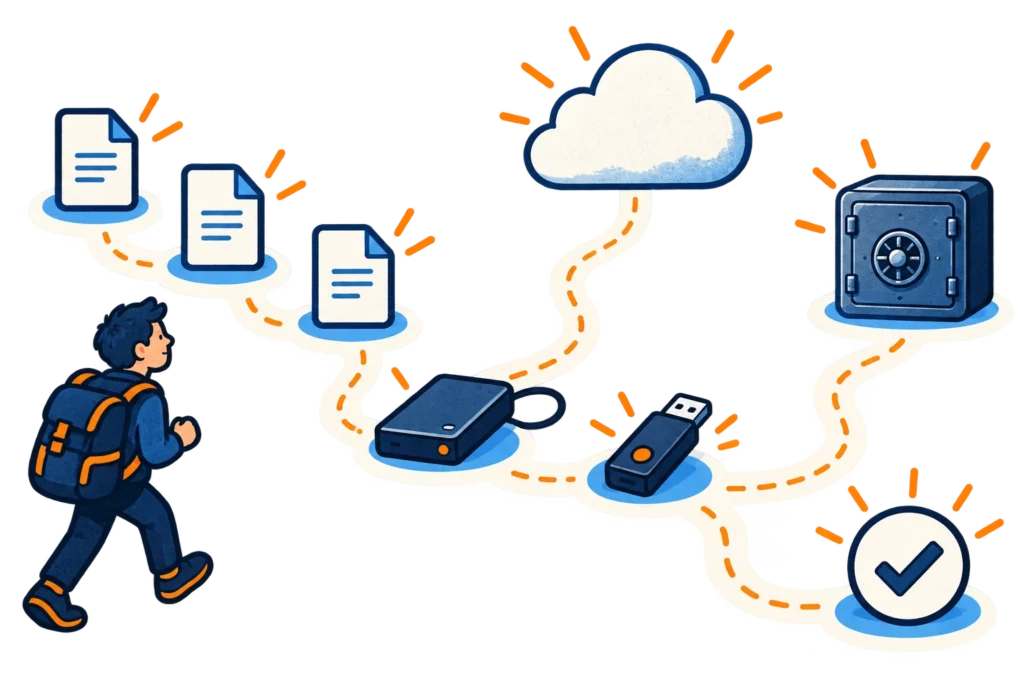
Cyberattacks continue to increase, and attackers develop new ways to reach sensitive information and backup systems. In ransomware attacks, an attacker sometimes also targets backups to prevent the organization from recovering data without paying.
Established backup rules are therefore not always enough on their own. An additional layer of protection is needed: that is the idea behind the 3-2-1-1-0 rule.
The formula for stronger protection
More copies. More separation.
Less risk of data loss.
What is the 3-2-1-1-0 backup rule?
The rule requires five conditions:
The combination improves the chance of recovery: an isolated copy is inaccessible to malware over the network, an off-site copy remains available after a local disaster, and different media avoid dependence on a single storage technology.
How to remember the rule
- At least 3 copies
- 2 storage technologies
- 1 copy outside the business
- 1 copy that cannot be modified
- 0 backup errors
What is the difference between 3-2-1 and 3-2-1-1-0?
For years, 3-2-1 was a widely accepted standard: three copies, two storage types and one off-site copy. The rise in attacks targeting backup systems created a need for additional protection.
- Three copies
- Two types of media
- One off-site copy
- All the protections of 3-2-1
- An additional isolated or immutable copy
- Verification that backup completed with zero errors
These two additions significantly improve the ability to recover data after malware, physical damage or human error.
What does the older rule gain?
- A copy locked against modification
- Actual integrity verification
The additional 1 protects the copy.
The 0 confirms it can be relied on.
Implementing the rule with BackupONE
Backup plans can cover different data types: files, full image backups, servers, SQL databases, virtual machines and SaaS applications such as Microsoft 365 and Google Workspace. Copies can be retained locally and in the cloud according to organizational policy.
The additional 1: immutability and Object Lock
Object Lock on compatible storage can create an immutable copy. During the lock period, the copy cannot be modified or deleted, making it harder for a compromised account or malware inside the network to damage it.
Some storage services offer Governance and Compliance modes. Governance mode can allow authorized users to bypass the lock; Compliance mode applies stricter protection and prevents modification until retention ends. Choose the mode according to policy, regulatory requirements and business needs.
The 0: backup completed without errors
Zero is more than a mark in a report. Verify that the job succeeded, files are available and recovery tests take place regularly. An untested backup is not proof of recovery capability.
Check the 0
- Did the job complete successfully?
- Were no files skipped?
- Is the copy locked according to policy?
- Was a test restore performed?
Start by mapping data before configuring jobs
To turn 3-2-1 into an action plan, list the systems essential to the business, their owners and where their data is stored. Distinguish everyday documents, databases and complete systems: each group may need a different backup method and recovery path.
For each group, decide what must be restored and to which destinations. Then check where the source and two backups will be, their media types and which copy is off-site. Add suitable separation or locking and integrity checks. A list of disks is not a backup plan: you must also know what data they hold and how work will resume.
Assign checks and practise recovery too
Decide in advance who reviews backup reports, who handles exceptions and when recovery tests take place. A good test runs in a separate environment, verifies that files open and the system works, and documents the steps and recovery duration. A successful job alone does not guarantee every future restore will succeed.
Match the plan to data types and organizational needs, and update it when the environment changes. Further reading: Recovery testing guide andDaily backup monitoring guide.
Summary
The 3-2-1-1-0 rule creates a more resilient backup strategy: multiple copies, separation across technologies and sites, an isolated or immutable copy and integrity verification. This improves the chance of recovering data and continuing work after ransomware, physical failure or human error.