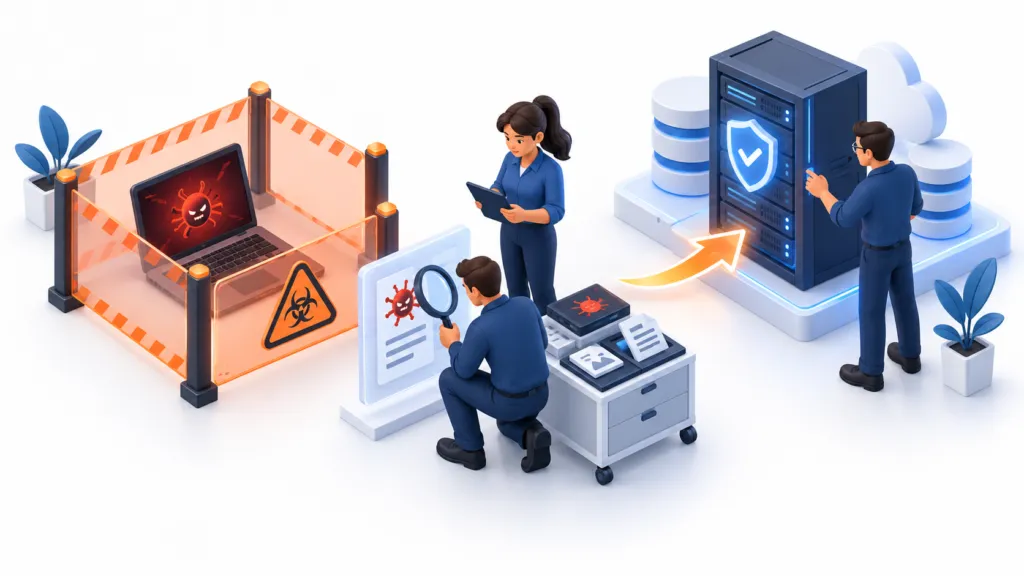
There is a sign of data breach. What should be done first, who should be notified, and how can the incident be prevented from spreading? Malware, human errors, negligence, and software or hardware failures can cause damage or leakage. A service provider cannot guarantee zero risk, but it can reduce exposure and prepare a clear and flexible response plan.
The key principles
- Detect and isolate
- Preserve evidence
- Restore and draw lessons
A response plan helps to act quickly and in a coordinated way to minimize impact on the customer's operations. Here we will go through preparation, the response team, and handling stages. During the event, it is advisable that everyone follows the same plan, rather than three versions of 'what is usually done.'
Important decisions are prepared in advance
The source describes attackers who plan targeted attacks according to security controls and remaining vulnerabilities. It also mentions scans for exposed remote access services and weak passwords, such as admin111, and emphasizes the risk from basic misconfigurations and careless access to security.
Organize documentation and workflows.
It is not possible to protect against every event. The source recommends defining responsibility and expectations in the service level agreement (SLA) and in the main service agreement. It warns against committing to a fixed time for resolving each event or zero probability of impact.
Conduct a security review
Conduct a basic security review, identify vulnerabilities, and address them promptly. If there is a gap that cannot be easily closed, update the client management. A recognized and documented risk is preferable to an unspoken surprise.
Plan according to scenarios
After addressing the obvious gaps, consider possible impact scenarios. A plan for each scenario can reduce the consequences of an attack or data loss.
Define communication with the client
Prepare a clear contact list for the event: who needs to be notified and how to reach them. It is advisable that it be accessible when needed, and not depend solely on a system that may be compromised.
Take into account the applicable obligations
If the client is subject to compliance requirements, they must be considered in the plan. An IT provider may manage and process client information. The source cites as examples medical information subject to HIPAA and information subject to GDPR.
Who needs to know, and who needs to act?
Share the response plan with the provider's team and the client's team. Everyone needs to understand their role in different scenarios. During an incident, good coordination saves both time and conflicting actions.
The internal team
The team should include the provider's technology personnel, relevant client employees, and management. A shared level of awareness is required to act according to the scenario.
Management should understand what actions are required during an incident, and employees should know how to report and communicate with the provider. The service provider leads actions within its responsibility, provides the client with necessary information, and executes the response plan.
If a third party provides security services, for example an MSSP or a security operations center team, also involve them in coordination with the internal team.
The external team
In some cases, the investigation is conducted by an external party, such as government auditors or security experts appointed by a cyber insurance company. The source recommends providing them with the required information upon their request.
What might indicate that something went wrong?
A full SIEM system for managing security information and events is not necessarily the right choice for every small team. It requires investment, knowledge, and staff to manage it. If you are not prepared to provide such a service, cooperation with a managed security provider can be considered.
Even without a complex SIEM, systems and networks need to be monitored. Logins at unusual hours, suspicious IP addresses, or disabling antivirus and firewalls are examples of signs worth checking. An alert does not always mean there has been a breach — but it does mean there is something to investigate.
An incident has been identified. Now we work according to the plan
Notify the client team
When an incident is identified or reported, quickly update the client's management and the response responsible parties. Explain what is known and what actions are planned. Clear information allows the team to act without having to fill in the gaps themselves.
Assess the situation and isolate the damage.
Check which systems were affected and what is happening with them: is malware spreading, or is an attacker controlling part of the infrastructure? According to the situation and the response plan, isolate affected systems and change any exposed access details. Actions should also be coordinated with evidence preservation, as detailed below.
Identify the point of entry.
Meanwhile, try to understand how the damage occurred, find the vulnerability, and address it.
Consider notification to the relevant authority.
The source emphasizes that there may be a reporting obligation when it involves medical, financial, or personal information, and failure to meet relevant requirements may result in fines.
Investigate the incident
After containing the breach, collect detailed information from the systems to build a complete picture of the causes: technical failure, human error, intrusion, or a combination of these.
Assess the damage and define the actions that will allow the client to return to operation quickly. These may include the restoration of data and systems, hardware replacement, and network verification.
Produce a summary report
At the end of the investigation, prepare a report for the internal response team. It should include:
- Event overview: who identified it and when, its nature, the actions taken in response, its consequences, and additional required information.
- Action plan: addressing detected vulnerabilities and steps to prevent similar incidents.
Complete the handling, and then learn from the incident
Leakage, damage to production systems, or intrusion can also harm the service provider's reputation. Therefore, it is not enough to just stop the incident: the nature of the damage and the root causes are examined. A thorough investigation helps identify gaps and improve protection for the next time.