
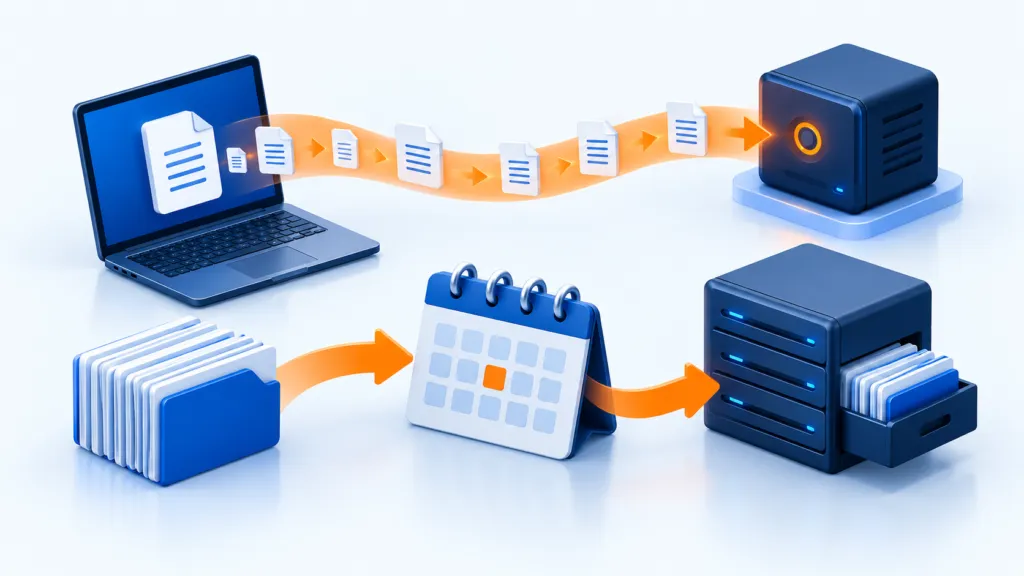
When important documents change many times during the day, nightly backup alone may leave a large gap. Real-time or near-real-time backup aims to reduce that gap by detecting changes and copying them frequently.
Copies close to the time of work
- Changes are transferred frequently
- Historical recovery points are retained separately
- Load and recovery are tested
What does real time mean?
Behavior depends on the software, source type and connection to the destination. Detecting a change does not guarantee that a copy is written immediately. Check latency, queues, retries and what happens when the computer or destination is unavailable.
When should you consider it?
Active folders containing relatively small files may be suitable where losing hours of work is unacceptable. Define a focused data set and test whether the frequency actually narrows the recovery gap without disrupting work.
Large files and active applications need testing
A large file that changes regularly may create transfer and storage load. Open files, databases and network folders may need an appropriate backup method. Do not assume that change tracking creates an application-consistent copy.
Retain history and protection too
Fast copying can also quickly transfer damaged content. Combine version retention, a protected copy and appropriate permissions. High frequency does not replace separation or guarantee a zero RPO.
What should you measure?
- Time from a change to a recoverable copy.
- CPU, disk and network load.
- Growth of historical data over time.
- Open-file integrity and alerts about delays.
Scheduled or application-aware backup may suit other systems better.