
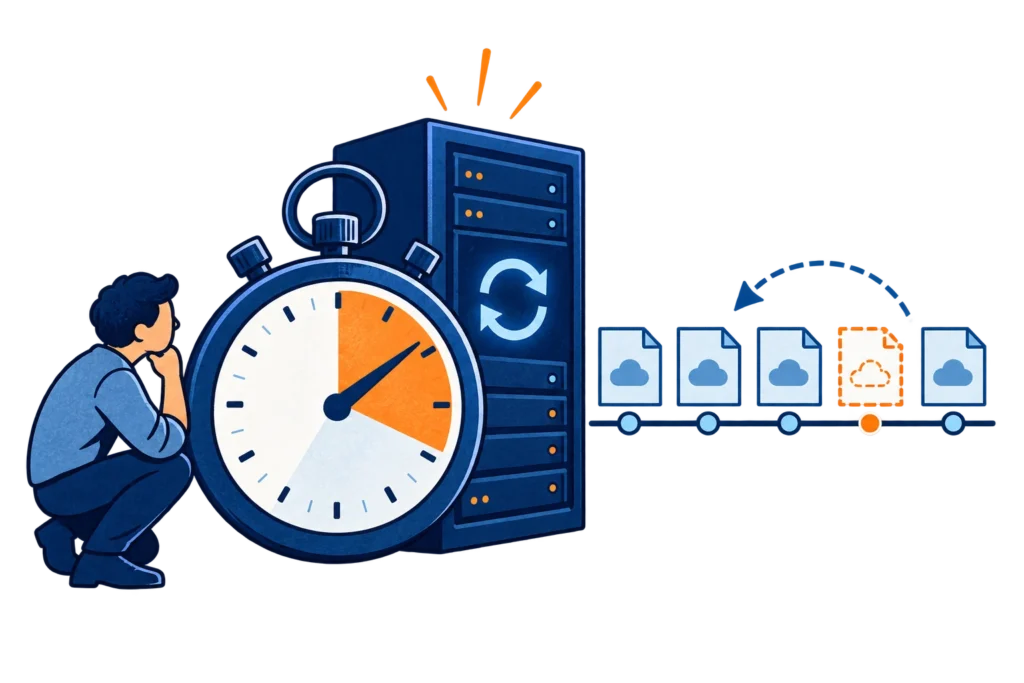
Recovery Time Objective (RTO) and Recovery Point Objective (RPO) are two parameters that are important to define before building a business continuity and disaster recovery plan. Both affect the recovery process, but each answers a different question.
The difference in one sentence
- RTO deals with the time until service restoration
- RPO deals with the amount of information that may be lost
Downtime ≠ Data loss
What is RTO?
RTO — Recovery Time Objective — is the maximum period established for restoring IT infrastructure and services to operation after a disaster or failure. If the RTO is two hours, the organization must be able to resume normal operations within two hours from the start of the event.
If actual recovery takes longer than the target, the calculation should be reassessed, or the continuity plan, infrastructure, and procedures improved.
Factors to consider when determining RTO
- The business cost of each hour of downtime.
- The importance and priority order of each system.
- The necessary recovery stages, including dependent components and processes.
- The budget, personnel, and available resources.
Example: RTO of two hours
Failure
Return to operation
The clock measures downtime.
What is RPO?
RPO — Recovery Point Objective — defines the maximum amount of information, in terms of time, that the business can afford to lose. The metric helps determine how often to perform backups.
For example: if the backup is performed once a day at midnight and the failure occurs at 08:00, there may be a loss of eight hours of work. This situation meets an RPO of 24 hours, but does not meet an RPO of four hours.
In an active production environment, the downtime itself may increase data loss: while the system is unavailable, any new information that was supposed to be created, changed, or deleted is not recorded.
Factors to consider when determining RPO
- The maximum extent of data loss the organization can tolerate.
- The cost of lost data and its recovery.
- The budget and resources required for more frequent backups.
Example: midnight backup
Last backup
Failure
The window between the backup and the failure is the possible data loss.
Differences between recovery objectives
| Aspect | RTO | RPO |
|---|---|---|
| The central question | How long can the service be down? | How much information is permissible to lose? |
| What is measured | Time from the event until return to operation | Time from the last backup until the event |
| The main impact | Infrastructure, recovery processes, personnel, and system availability | Backup frequency, version retention, and data replication |
| Calculation complexity | Higher, as it affects overall operations | Often more focused on data usage patterns |
| Cost | A short RTO may require redundancy and fast recovery | A short RPO may require more storage and frequent backups |
RTO and RPO in disaster recovery planning
Realistic targets are the foundation of a reliable recovery plan. An RTO close to zero generally requires high redundancy, continuous replication, and rapid failover processes. A very short RPO requires frequent capturing and replication of changes.
The targets should align with the business need. If the business can tolerate four hours of downtime, but the infrastructure is designed to recover within two hours at high cost, it may be appropriate to reconsider either the target or the investment.
The balance formula
Risk + Cost + Technical capability
- Classify systems by criticality
- Define a target for each service
- Test in a real recovery
7 ways to improve RTO and RPO
Summary
RTO and RPO complement each other: the first determines how quickly the service must return, and the second determines to which point in time the data must be restored. When they are defined according to business impact, appropriate processes are built, and actual recovery is tested, downtime can be minimized, data loss limited, and business continuity maintained.